
Get My Payslips: Can't Find a Payslip? Complete Guide (2026) on How to Get Your Payslips
Realising you can't find a payslip usually happens at the worst possible moment — a mortgage broker asking for three months of records, or a tax return deadline creeping up. If you need to get my payslips reissued and aren't sure where to begin, this guide sets out every practical route available to UK employees, from payroll software to official HMRC channels.
Note: If you urgently need your Payslips, P60, or P45 and cannot wait for standard replacement requests through your employer or HMRC, A2Z Payroll offers accelerated document retrieval services. Visit: A2Z Payroll to request your documents — within 2 hours, A2Z Payroll has over 20 years' experience, in providing genuine payroll documentation.
Start With the Source: Your Employer's Payroll System
Before requesting anything, it's worth checking whether the payslip already exists somewhere you have access to — many employees forget they still have login credentials for a payroll platform they rarely open.
Self-Service Payroll Portals
Platforms like Sage, Xero, IRIS, and BrightPay typically store a rolling history of payslips that employees can view or download at any time. If you've forgotten your password, resetting it usually takes a couple of minutes and avoids the need to contact HR at all.
Old Emails and Downloads Folders
Search your email for terms like "payslip," "payroll," or your employer's name. It's also worth checking a Downloads folder or any linked cloud storage, since payslip PDFs are often saved automatically by email clients or browsers.
Requesting a Copy From HR or Payroll
If self-service access isn't available, a short, specific email is usually all it takes. Include your full name, employee number (if known), and the exact pay period you need — this speeds up the search on their end considerably.
What to Include in Your Request
- Full name as it appears on your employment record
- Employee or payroll reference number
- Specific month(s) or week(s) required
- Reason for the request, if it affects urgency (e.g. mortgage deadline)
Typical Turnaround Times
| Request type | Typical turnaround |
|---|---|
| Recent payslip via self-service portal | Instant |
| Recent payslip via HR/payroll email | 1–3 working days |
| Archived payslip (over 1 year old) | 3–10 working days |
| HMRC employment history | Online: instant; by post: up to 15 working days |
Payslips From a Job You've Already Left
Leaving a company doesn't erase your payroll history. UK employers are required to retain payroll records for a minimum period after you leave, so a former employer should still be able to help if you need to get my payslips from a role you no longer hold.
How to Approach a Former Employer
Contact the HR or payroll department using the same details you'd use for a current job — full name, dates of employment, and the specific periods required. Most companies can pull archived records even if it takes a little longer than an active-employee request.
When the Employer No Longer Exists
This is the scenario where most people get stuck — and where HMRC becomes essential rather than optional.
HMRC's Personal Tax Account
Signing in to your HMRC personal tax account gives you access to income and PAYE data for previous tax years, which many lenders and letting agents will accept in place of an original payslip.
Requesting Records by Post
If online access isn't possible, HMRC can send employment history and income figures by post. Full details are available on the official gov.uk payslips page, which also explains your statutory entitlement to receive a payslip each pay period in the first place.
General Tax and PAYE Questions
For anything beyond payslip records — tax codes, PAYE calculations, or querying deductions — the HM Revenue & Customs website is the definitive source and can help clarify figures a reissued payslip doesn't explain.
HMRC records come directly from employer submissions, so they're widely accepted as reliable evidence even without the original document.
Quick answer: The fastest way to get my payslips is usually your employer's payroll portal or HR team. If that's not possible — for example, the company has closed — HMRC can supply your employment and income history instead. Also explore our main Get My Payslips landing page for additional options.
A Salaried Example: Monthly Payslip Breakdown
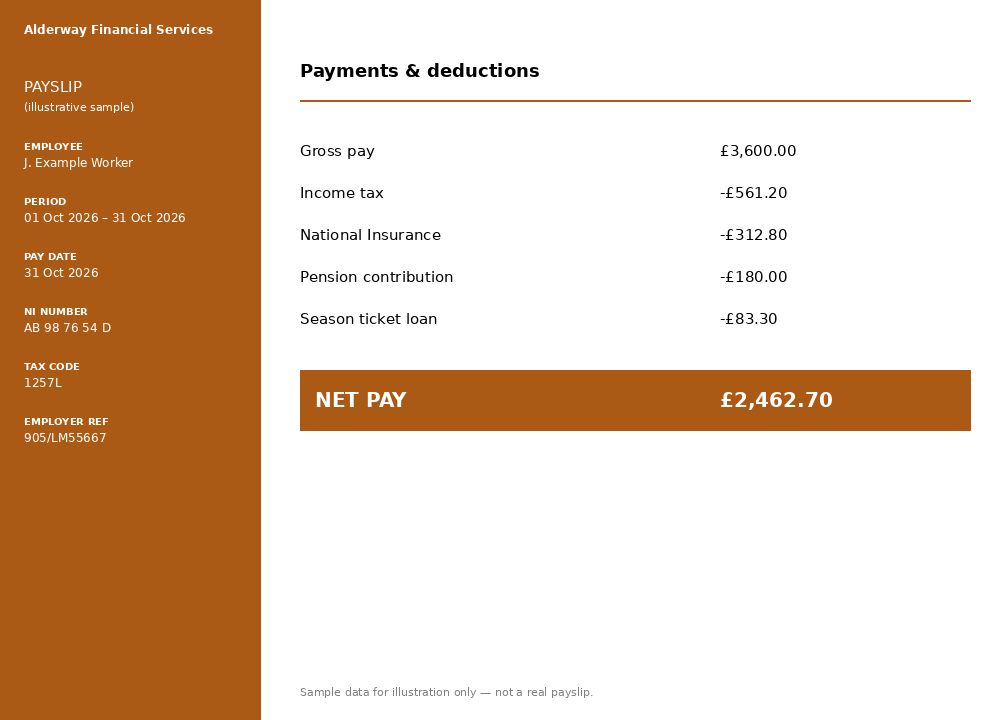
For context, here's what a typical salaried payslip looks like once tax, National Insurance, pension, and a season ticket loan repayment have all been applied.
Avoiding the Problem Next Time
Once you've managed to get my payslips sorted for the immediate need, it's worth spending a few minutes setting up ongoing access so you're not back in the same position next year.
- Register for your employer's self-service payroll portal, if one exists
- Turn on email notifications for each new payslip
- Save a PDF copy to a personal, backed-up folder each pay period
- Set up your HMRC personal tax account as a secondary record
Frequently Asked Questions
Where's the quickest place to get my payslips from?
Your employer's payroll portal, if they use one — most give instant access to several years of pay history. Without a portal, a direct email to HR or payroll is the next fastest option.
Can I request a copy of my payslip directly from HMRC?
Not the document itself, but HMRC holds the underlying PAYE income and employment data, accessible through your personal tax account or by postal request.
What should I do if the business I worked for has shut down?
Go straight to HMRC. Employer PAYE submissions stay on record even after a company stops trading, so your income history remains retrievable.
Do employers charge a fee to reissue a payslip?
Most reissue payslips free of charge, especially for recent periods, though older archived records may take longer to locate.
Can a payslip double as proof of address?
Payslips are widely accepted as proof of income, but not usually as proof of address, since they don't always list a current residential address.
Note: This post complements our separate article covering general payslip recovery. For broader options, read our comprehensive Lost Payslips guide instead.
Final Thoughts
A missing payslip is rarely a dead end. Between payroll self-service portals, a quick HR request, and HMRC's employment history records, there's almost always a way to get my payslips back in hand — even years after the fact. The best long-term fix is simply setting up self-service access now, so future requests take minutes rather than days.